
No platforming does not work; free speech must be defended.
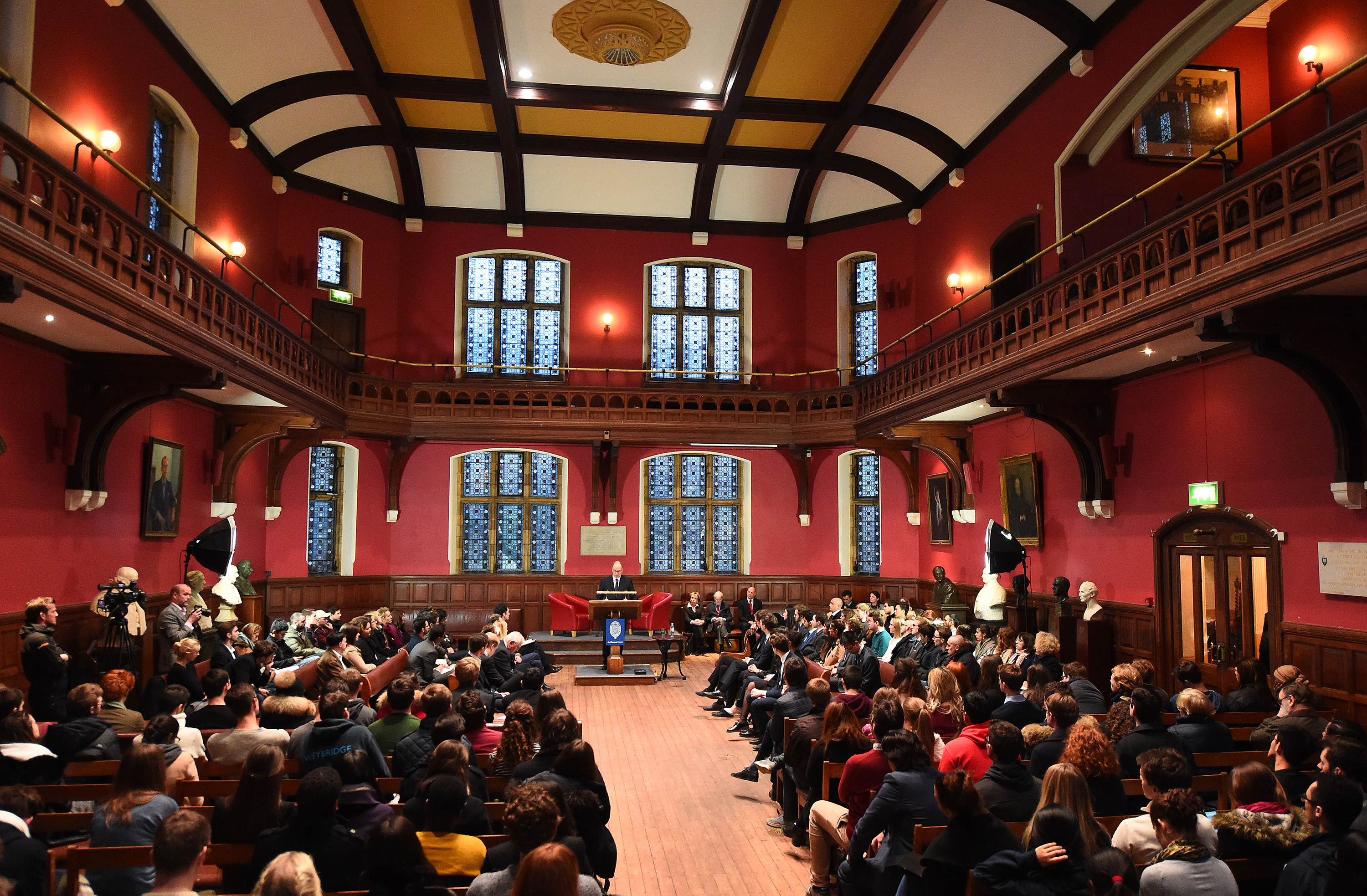
The announcement that Tommy Robinson, real name Stephen Christopher Yaxley-Lennon, has been invited to debate the motion “This House Believes the West is Right to be Suspicious of Islam” at the Oxford Union on 28 May has provoked a predictable storm of outrage. Student societies have issued condemnations, a senior Union adviser resigned, calling the decision a “clown show,” and protests are being organised outside the debate itself. Pickthall House supports Robinson’s right to speak at the Oxford Union and believes that those demanding cancellation are making a serious strategic and moral error.
To understand the stakes, it helps to understand the man. Stephen Yaxley-Lennon was born in 1982 in Luton, a town with a large Muslim minority, to a working-class family with Irish and English roots. He left school at 16 and took up an engineering apprenticeship at Luton Airport, losing that job after a criminal conviction for assaulting an off-duty police officer in 2003. He briefly joined the British National Party in 2004, then left the following year. In 2009, following a protest by Islamist extremists against returning British soldiers in Luton, he co-founded the English Defence League (EDL) with his cousin Kevin Carroll. Under his leadership, the EDL became defined by “violent street protests” against Muslim communities, gathering hundreds of former football hooligans under its banner. Robinson has adopted multiple aliases over the years, including Andrew McMaster, Paul Harris and Wayne King, and borrowed the name Tommy Robinson from a notorious Luton Town hooligan firm, initially to hide his identity.
He left the EDL in 2013, claiming he had recognised the dangers of far-right extremism, though few were convinced. In the years since, Robinson has continued producing anti-Islam content online, building a following of over 1.9 million on X and making videos that have accumulated tens of millions of views. He has been sentenced to five prison terms between 2005 and 2025, including for mortgage fraud, contempt of court, and the use of a friend’s passport to enter the United States. Most recently, in October 2024, he began serving an 18-month sentence after a court found him guilty of repeatedly publishing false allegations about Syrian refugee Jamal Hijazi, whom he had already lost a libel case to in 2021. Moreover, Robinson’s views include that Islam is “backward and fascist,” that the refugee crisis amounts to “a Muslim invasion of Europe,” and that Western countries should be deeply suspicious of Muslim communities. He has consequently called for mass deportation of Muslim men who entered the EU as refugees, and has spoken of wanting a Europe “free from halal food, free from Muslim rape gangs, free from the visual scars of minarets.” This is not a man whose ideas deserve to go unchallenged, which is precisely why this debate must happen.
Robinson’s popularity is not a mystery, and dismissing it as mere bigotry misses something important. Robinson gained popularity by speaking out against the grooming gang scandals in Rotherham, Rochdale, and other northern English towns, where hundreds of young girls, overwhelmingly white and working class, were subjected to systematic sexual abuse by networks of predominantly Pakistani-heritage men. Evidence shows that the authorities looked the other way for years. The UK government’s own recent social cohesion strategy acknowledged that group-based child sexual exploitation disproportionately involving perpetrators of Pakistani heritage is a real and serious problem that requires open discussion. Robinson identified and exploited the fury that followed revelations of these failures. He has also benefited from a widespread perception among his supporters that mainstream politicians and media have treated concerns about Islamist extremism, integration, and cultural change as inherently racist. Where the establishment sees sensitivity, many working-class voters see evasion. His “Unite the Kingdom” rally in September 2025 drew over 100,000 people to central London, and his affiliated political group, Restore Britain, polls at around 4% nationally, indicating a relatively high share of Brits who support far-right anti-migrant stances. Reform’s major wins in the local elections last week also reflect people’s dissatisfaction with more centrist and Left-leaning parties.
This is precisely why no-platforming him is so strategically foolish. Refusing him a stage at Oxford will not suppress the anxieties he channels; rather, it will allow him to market himself (with considerable effectiveness) as the lone truth-teller being silenced by a cowardly elitist establishment. As Oxford Union president Arwa Elrayess has rightly observed, “for two decades, the primary strategy of the Left when confronting far-right ideas has been silence: refuse a platform, deny a debate, and hope the problem goes away.” The results speak for themselves.
There is a well-worn argument that platforming extremists legitimises them and amplifies their reach, and while it sounds intuitive, it’s not necessarily true. When Robinson speaks at the Oxford Union, he will be challenged by theologians, Muslim scholars, and political figures who can expose the falsity of his claims in real time, before a live audience and a watching public. The Union’s own president, a Muslim of Palestinian heritage, has made the point directly, drawing on her experience of a previous debate where she invited an Israeli soldier to speak. Audience members, she said, “left changed, not because I asked them to stay away, but because I asked them to listen.”
To be clear, Pickthall House does not welcome Tommy Robinson’s views, and we reject the motion he is being invited to defend. We do not believe the West is right to be suspicious of Islam as a religion, and we find much of its rhetoric about Muslim communities factually wrong. But we also believe, without reservation, in the legal right to criticise Islam. No religion should be above scrutiny. Throughout its 200-year history, the Oxford Union has invited speakers whose views were considered dangerous, offensive, or simply wrong, among them figures such as Holocaust denier David Irving, Katie Hopkins, O.J. Simpson, Marine Le Pen, and Richard Nixon. The value of those encounters was never that the Union endorsed their views, but that ideas subjected to rigorous public debate are more likely to be properly understood and evaluated than ideas suppressed and left to metastasise in the dark.
Pickthall House therefore believes that if the Muslim community want to make the case that Robinson’s picture of Islam is false, the Oxford Union debate on 28 May is a great opportunity.