
The United Kingdom has taken worrying steps toward curbing political dissent and narrowing the boundaries of free expression. This demonisation of free speech has allowed figures like Lucy Connolly - who called for migrant hotels to be set on fire in an online post - to become martyrs for the right wing. Her words were vile, but the heavy-handed response has turned her into a right-wing symbol of "free speech under attack." It's a perverse outcome where extremist voices get to play victim while their dangerous messages get lost in arguments about censorship. Over-criminalisation doesn't stop hate speech - it just gives it a bigger megaphone.
The case of Connolly fits into a larger pattern. Across the UK, people from all walks of life have faced investigation or sanction for things they said online or in public. A teenager was arrested for posting rap lyrics on Instagram. A Conservative councillor was forced to resign after criticising the Black Lives Matter movement. Police visited comedian Joe Lycett over a satirical social media post. Teachers, students, and campaigners have faced scrutiny for views that are sometimes offensive, sometimes clumsy, and sometimes simply unpopular.
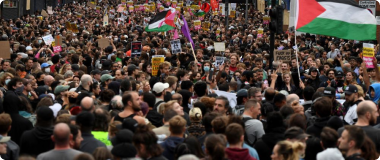
This broader trend of criminalising protest and over-policing speech has reached a new extreme with the government's decision to proscribe the activist group Palestine Action as a terrorist organisation. Palestine Action is a direct-action network targeting companies that supply arms used in the Israeli-Palestinian conflict. Its members have staged occupations, disrupted business operations, and engaged in civil disobedience aimed at the arms trade. Their tactics are confrontational and often damaging to property, but they are not violent in the traditional sense usually associated with terrorism. To fold this type of activism into counterterrorism law is a dramatic escalation. Terrorism legislation was written to deal with groups that pose an immediate threat to life and national security.
The consequences are severe. Once an organisation is proscribed, even voicing sympathy with its aims can be treated as criminal. A tweet, a speech, or a slogan expressing solidarity with Palestine Action may now be viewed as providing support for terrorism. This creates a dangerous precedent in which political solidarity itself becomes a legal risk.
The increasingly heavy-handed policing of protest has become absurd in its scope. In August, a man was arrested at a demonstration for wearing a t-shirt parodying the government’s decision against Palestine Action. His shirt read “Plasticine Action – we oppose AI-generated animation.” More than half of those arrested at the same protest were over the age of 60. Cases like this may seem ridiculous, but they reflect the increasingly heavy-handed policing of protest.
New laws have accelerated this shift. The 2022 Police, Crime, Sentencing and Courts Act and the 2023 Public Order Act give authorities broad powers to restrict demonstrations on grounds as vague as “serious annoyance.” Civil disobedience, once seen as a legitimate part of democratic life, is increasingly framed as illegitimate. From the suffragettes to the anti-apartheid movement, Britain has a long history of protest that was disruptive and often unpopular at the time. Today, those same forms of activism would likely be criminalised.
It is tempting to treat this as a debate confined to one side of politics, with conservatives complaining about “cancel culture” and progressives calling for more decisive action against hate speech. However, the reality is that the current culture of censorship transcends ideology. Both left and right have faced sanctions. Governments of all parties have supported broader surveillance powers and stricter restrictions on protests, alongside the wider use of counterterrorism laws.
The justification for these measures is often national security or public order. But a society that restricts dissent in the name of stability loses the very qualities that make it stable in the first place. The strength of democracy lies in its ability to accommodate anger, disagreement, and protest without resorting to criminalisation. Now the UK risks becoming a country where dissent is feared, debate is narrowed, and political expression is treated with suspicion.